
Why Evangelize Uses AI-Augmented Technology Business Management within its Performance Framework (EPF)
Technology Business Management (TBM) was designed to answer a deceptively simple question: where is technology spend actually creating value? In principle, TBM delivers transparency, comparability, and an economic lens through which technology decisions can be made like any other business investment. In practice, most implementations fall short. They become expensive reporting exercises—dependent on manual effort, slow to refresh, and disconnected from real decisions.
David Hole
2/5/20266 min read
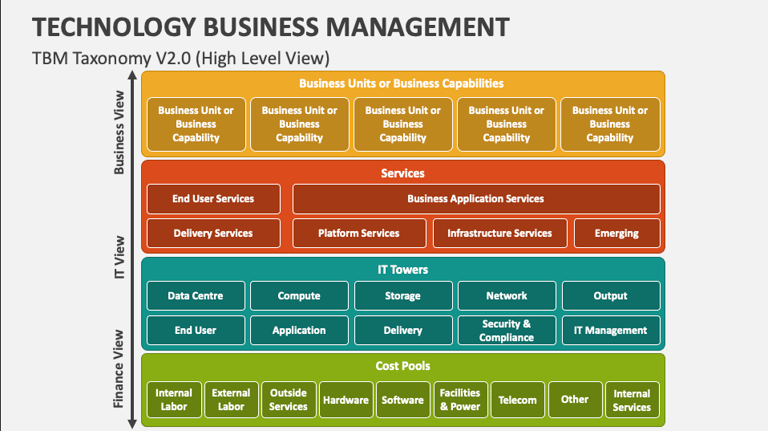
Technology Business Management (TBM) was designed to answer a deceptively simple question: where is technology spend actually creating value?
In principle, TBM delivers transparency, comparability, and an economic lens through which technology decisions can be made like any other business investment. In practice, most implementations fall short. They become expensive reporting exercises—dependent on manual effort, slow to refresh, and disconnected from real decisions.
The problem is not TBM itself. The problem is that traditional TBM was designed for a simpler world: slower change, stable estates, fewer suppliers, and clearer cost structures. That world no longer exists.
Modern organisations operate with cloud elasticity, product-centric funding, rapid supplier churn, hybrid operating models, and constant transformation. TBM is evolving from a static transparency model into a living, decision-grade economic system.
This is why Evangelize embeds AI-augmented TBM directly within the Evangelize Performance Framework (EPF). AI is not a bolt-on or visual enhancement—it is what allows TBM to remain accurate, relevant, and decision-useful under conditions of complexity and uncertainty.
1. From Static Allocation to Continuous Economic Learning
Cost classification is TBM's foundation. If costs are misclassified, every downstream insight is compromised. Yet this is where most programmes expend disproportionate effort and still fail to achieve confidence.
Traditional classification relies on manual mapping of general ledger entries, periodic reconciliation workshops, rule-based allocation logic, and one-off clean-up exercises. This approach is slow, expensive, and brittle. It assumes cost structures are stable and that people can consistently interpret ambiguous financial data.
In reality, coding errors, supplier changes, architectural evolution, and organisational restructuring constantly erode accuracy, and we are finding that most companies' financials are inherently wrong when it comes to technology cost allocation.
Evangelize replaces this fragile approach with AI-driven classification models that operate directly on raw finance data and from the technology teams themselves.
These models automatically classify spend across services, products, capabilities, and value streams. They detect miscoded, duplicated, or ambiguous costs using statistical and semantic signals. Critically, they flag uncertainty explicitly rather than forcing false certainty, and they learn continuously from corrections, improving allocation accuracy over time.
The shift is from periodic correction to continuous learning.
Instead of re-running classification exercises annually, the model improves incrementally, cycle by cycle, which leads to two material impacts following.
First, manual effort collapses; finance and IT teams spend time validating insights rather than wrestling with spreadsheets.
Second, confidence increases; stakeholders trust the numbers because uncertainty is surfaced, not hidden.
In EPF terms, this is what allows TBM to be used credibly in the Assess and Design stages, rather than being dismissed as "directionally useful but not reliable".
2. Moving Beyond Human-Scale Analysis
Even when costs are well classified, most organisations fail to extract real insight from TBM data. The amount of data, the variety of dimensions, and technology bias are limitations on human analysts. As a result, many TBM insights are retrospective and obvious in hindsight: costs have grown, there is duplication, and cloud spend is increasing.
AI changes this by enabling continuous pattern recognition across the entire technology estate.
Evangelise's AI-augmented EPF identifies signals that human analysis would miss or find too late. We specifically look for non-linear cost growth that defies explanation by demand. Identification of overlapping services delivering similar outcomes to the same user groups creates demand spikes that are operationally justified but economically irrational and often affect supplier concentration patterns that introduce resilience or negotiation risk.
These patterns are not merely descriptive; they are diagnostic. They point to structural issues in operating models, sourcing strategies, architectural decisions, or governance mechanisms.
Crucially, these signals feed directly into EPF's Diagnostic & Opportunity Analysis Report (DOAR), shortening the path from data to decision by answering three questions quickly and rigorously: Where is value leaking? Why is it happening? Which levers will actually change the outcome?
Without AI, these insights arrive late or not at all. With AI, they emerge early enough to shape priorities rather than justify them after the fact. Understanding this allows Evangelize and EPF to be able to drive cost optimisation before costs spiral out of control.
3. Replacing Certainty Theatre with Decision Reality
One of the most dangerous artefacts in transformation is the single-number forecast. Traditional TBM models often present precise-looking figures that imply stability and control, even when underlying conditions are volatile.
This creates what Evangelize refers to as certainty theatre: numbers that look authoritative but collapse under scrutiny or execution.
AI-enabled TBM allows Evangelize to model uncertainty honestly and explicitly. This includes multiple future-state cost scenarios based on demand, architecture, and sourcing choices; sensitivity analysis showing which assumptions actually drive outcomes; demand-led forecasting that reflects consumption behaviour rather than historic spend; and benefit probability ranges rather than deterministic claims.
Within EPF, this capability is critical to the Design and Five Case stages. It allows leaders to see the economic consequences of different design choices, the risk-adjusted value of competing options, and the cost of delay associated with inaction.
Instead of debating whose numbers are "right", decision-makers can debate which risk profile they are willing to accept. This is a far more mature and defensible basis for investment decisions.
4. From Lagging Indicators to Early Warnings
Most governance frameworks rely on lagging indicators. Risks are logged once problems are visible, issues are escalated once deadlines slip, and cost overruns are explained after they occur.
Evangelize integrates TBM data with AI-enhanced RAID analytics to reverse this dynamic.
By correlating cost behaviour, delivery signals, and historical execution patterns, AI can predict likely cost overruns before they materialise, identify early signs of benefit erosion, surface delivery bottlenecks that historically lead to failure, and highlight compounding risks across dependencies rather than in isolation.
This fundamentally changes the role of governance. RAID registers move from compliance artefacts to predictive control mechanisms.
In EPF, this capability underpins the Orchestrate stage, allowing leadership teams to intervene while options still exist. The result is not perfect delivery, but materially fewer surprises—and significantly reduced downside risk.
5. Ensuring TBM Drives Decisions, Not Just Reports
A final but critical failure mode of TBM is adoption. Even accurate, sophisticated models fail if their insights are not understood or used by decision-makers.
Executives do not lack intelligence; they lack time. Dense charts, specialist terminology, and financial abstraction create friction that leads to disengagement.
Evangelize uses AI to translate TBM outputs into decision-ready narratives: clear explanations of economic drivers and trade-offs, plain-English summaries of what is changing and why, and explicit linkage between insights and decisions required.
This translation layer ensures TBM is consumed at the board and executive level, not filtered through intermediaries who may dilute or distort the message.
The result is that TBM becomes embedded in governance, not parked alongside it.
What Makes This Fundamentally Different
Evangelize does not treat TBM as a reporting dashboard, a finance-only transparency exercise, or a static annual cost model.
Instead, TBM operates as a living economic model of the technology estate—fully integrated with EPF artefacts such as DOARs, target operating models, and Five Case business cases, and continuously refined through AI feedback loops and execution data.
TBM is not an end in itself. It exists to improve value decisions: what to invest in, what to stop, what to redesign, and how to govern execution.
If an insight does not change a decision, it is not TBM—it is noise.
Because TBM is embedded, AI-augmented, and decision-centred, the EPF approach delivers outcomes that traditional methods cannot.
Value leakage is exposed early, before it becomes structural. Design decisions are economically grounded, not driven by fashion or internal politics. Business cases withstand scrutiny because they reflect uncertainty rather than deny it. Execution risk is actively managed rather than retrospectively explained. Benefits are measurable, attributable, and defensible.
This is why EPF consistently avoids the failure patterns seen elsewhere: optimistic approvals, weak economic grounding, reactive governance, and silent write-offs.
Closing Perspective
Anything that does not include an element of AI is going to struggle in the modern world, and TBM without AI is not going to be the exception.
AI without TBM lacks economic discipline. Evangelize brings the two together—not as separate tools, but as an integrated decision system that allows strategic decision-making with the facts, not gut feeling. This integration is crucial for companies looking to stay competitive and thrive in the digital age.
We believe that exploring how the integration of AI with TBM (Technology Business Management) will enhance decision-making processes by providing real-time data analysis and predictive insights. This in turn will magnify the importance of proactive management strategies that utilise AI technology within the framework of TBM, as opposed to reactive approaches that may lead to failures in project approvals and governance.
Over the past year we have seen companies and organisations that have successfully implemented an integrated approach of AI and TBM, highlighting the measurable benefits and outcomes achieved, and what is very important to highlight is that no two companies have done this the same way. The challenges and considerations involved in adopting AI within a TBM system include ensuring economic discipline, establishing clear metrics for success, and addressing any potential barriers to implementation, and these can be outcomes reached in a variety of ways.
Lastly, it is worth exploring the implications for businesses that do not embrace this integrated decision system. How will those businesses struggle to adapt to modern complexities and potentially fall behind competitors who leverage AI technology within their TBM practises? What will be the outcomes for those companies that do not drive the level of clarity and service delivery that the competition is moving towards? Will they be able to survive in the ever-evolving market landscape?
In an environment where technology spend is inseparable from business performance, economic clarity is a strategic capability. AI-augmented TBM, embedded within EPF, is how Evangelize ensures transformation delivers real, measurable, and sustained value—it absolutely isn't just an activity; it is a key component of success.